
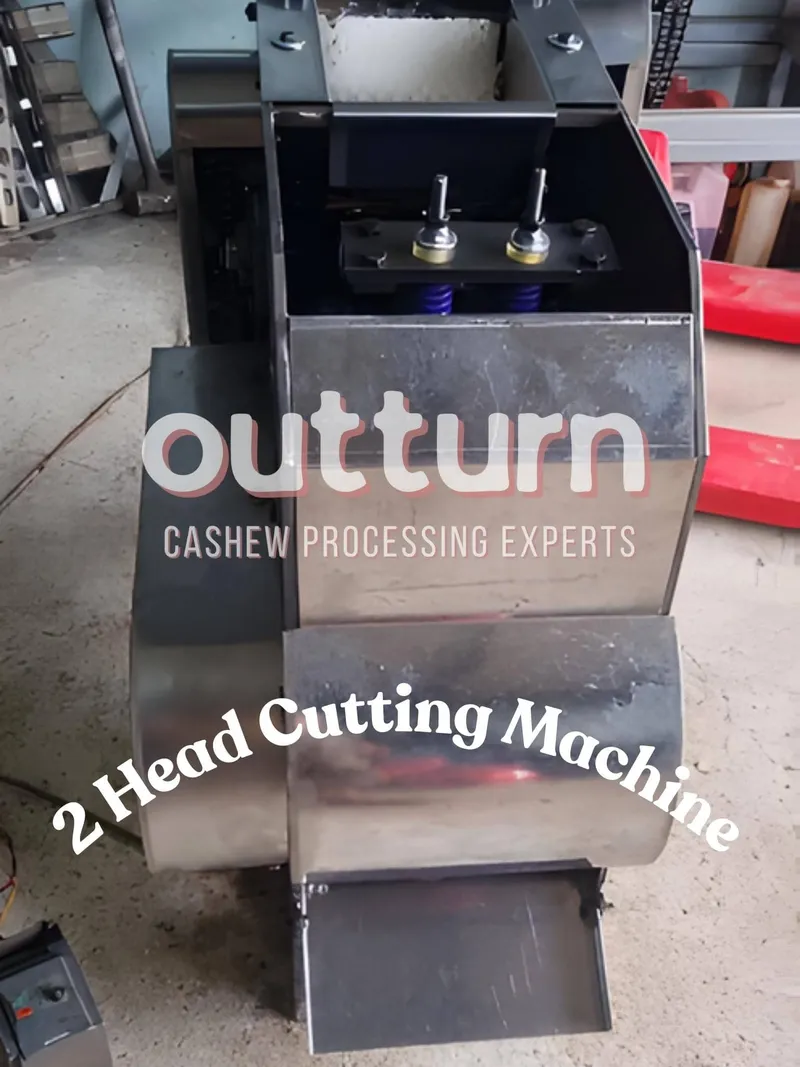
The 2-head OUTTURN cutting machine is the smallest unit in OUTTURN’s head-count range, purpose-built for processors who need real mechanized cutting without the footprint, power draw, or upfront cost of a multi-station line. It suits pilot runs, quality-control testing on new raw cashew nut (RCN) lots, and small operations that process in the tens rather than hundreds of kilograms per hour.
A Compact Entry Point Into Mechanized Cutting
Manual cutting with a handheld knife is slow, inconsistent, and hard on an operator’s hands over a full shift. The 2-head machine keeps the same manual feel — an operator still loads and unloads every nut by hand — but replaces the knife with a fixed blade and a rotating cup mechanism that delivers a consistent, repeatable cut. For a small processor, that consistency matters more than raw speed: it reduces kernel breakage, standardizes cut quality across a batch, and gives a new operator a shorter learning curve than freehand cutting.
How the Rotary Cutting Mechanism Works
Every OUTTURN machine, regardless of head count, uses the same basic principle: cups hold individual nuts and rotate into a fixed blade plane on a continuous cycle. On the 2-head model, two cups work in alternation. While one cup is positioned at the blade for cutting, the other is available for loading or unloading, so the operator’s hand motion and the machine’s cutting motion overlap rather than compete for time.
This rotary approach depends on proper upstream preparation. Nuts are steamed beforehand to soften the shell along its natural seam, which lets the blade separate shell from kernel cleanly instead of crushing through it. Machine setup and operator technique — how squarely a nut is seated in the cup — have a real effect on outturn, which is why results on the same machine can vary between operators and between RCN lots.
Scaling From 2 Heads to 12
OUTTURN builds its entire cutting machine range around the same core design: the same cup-and-blade mechanism, scaled mainly by adding cutting stations rather than by installing proportionally bigger motors. A 2-head machine and a 12-head machine cut nuts the same way; the difference is how many stations, and therefore operators, can work in parallel. Motor size holds at 1 HP (0.75 kW) from the 2-head through the 8-head, then steps up modestly for the two largest models — 1.5 HP on the 10-head and 2 HP on the 12-head — so even the biggest machine in the range draws far less power relative to its output than its capacity would suggest.
This matters for buyers planning growth. A processor can start with one or two 2-head machines to validate their process, staffing, and quality targets, then add higher head-count machines or additional units as volume grows, without retraining operators on a fundamentally different cutting method. The 2-head unit is not a scaled-down or simplified version of the larger machines — it is the same mechanism at the smallest practical scale.
Where This Machine Fits in a Processing Line
The 2-head cutter is typically placed after steaming and cooling, and feeds directly into peeling, grading, and drying stages. Because its footprint and power needs are modest, it works well in facilities that don’t yet have three-phase power, in trial production areas separated from a main factory floor, or as a backup or overflow station alongside larger machines during peak intake periods.
For processors uncertain about committing to a large installation, starting with a 2-head machine offers a lower-risk way to measure real-world outturn and throughput on their own RCN before scaling the cutting line further.