
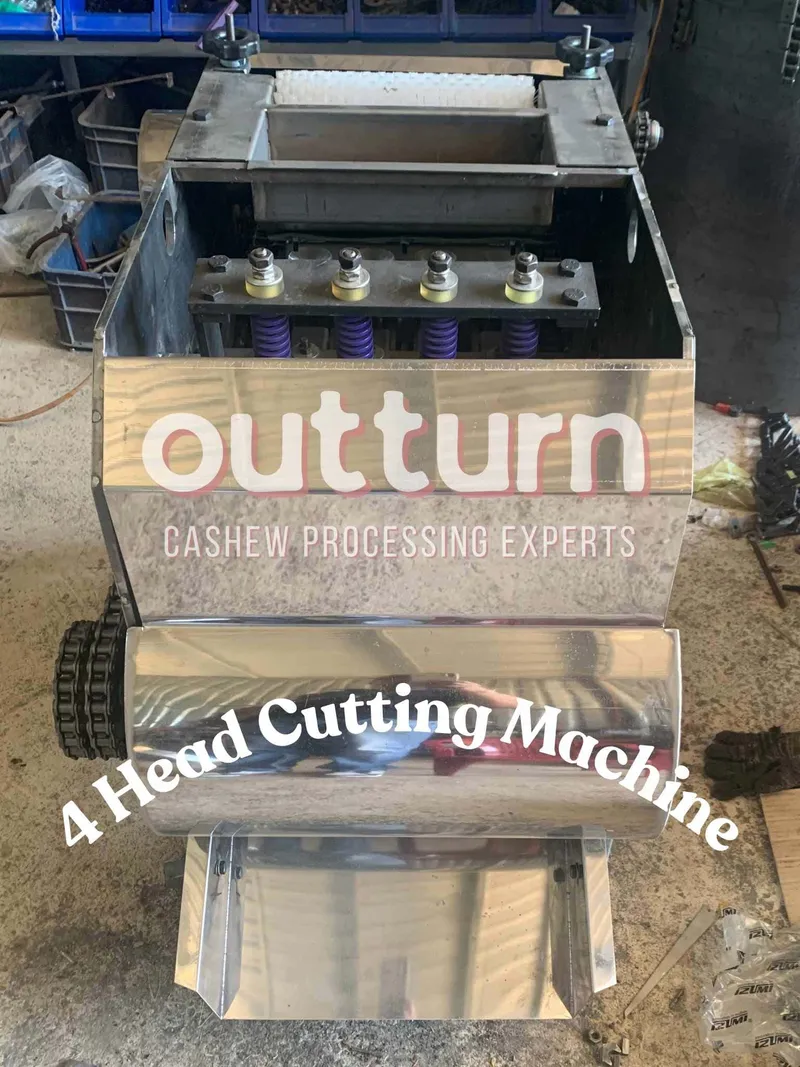
Built for the Small-to-Mid Processing Line
The 4-head OUTTURN cashew nut cutting machine sits at the entry point of OUTTURN’s head-count range, designed for processors who need more consistent output than manual cutting boards can deliver but aren’t yet running a full industrial line. With four rotary cutting stations mounted on a single welded steel frame, it handles 80–100 kg/hr of raw cashew input while keeping the same mechanical principle OUTTURN uses across its entire 2-to-12-head lineup.
How the Rotary Cutting Mechanism Works
Every OUTTURN machine, regardless of head count, cuts cashew shells the same way: steamed nuts are seated in shaped cups mounted on a rotating carousel, and the motor drives that carousel through a continuous cycle that carries each nut into a fixed blade plane. As the cup passes the blade, the shell is scored along its natural seam rather than crushed, letting the two halves separate cleanly so the kernel can be lifted out whole.
On the 4-head model, this cycle repeats across four stations simultaneously. While one station is being unloaded by the operator, the other three continue advancing nuts through their blades, which is what lets a single small machine sustain a steady 80–100 kg/hr throughput rather than stopping and starting with each cut.
How Motor Size Scales From 2 to 12 Heads
A question we hear often from processors comparing head counts: how much bigger does the motor get as you move up the range? Less than you would expect. The 2-, 4-, 6- and 8-head machines all run the same 1 HP (0.75 kW) motor — this 4-head included. Only the two largest models step up: 1.5 HP (1.1 kW) on the 10-head and 2 HP (1.5 kW) on the 12-head.
The reason is that cutting force in this design comes from blade geometry and the mechanical leverage of the cup-and-carousel system, not from raw motor torque applied to each nut individually. The motor’s job is to drive the shared rotary mechanism at a steady speed; each cutting station does its own work as it passes through the blade plane.
That means adding heads adds throughput far faster than it adds motor cost or energy draw — across the full range, capacity rises around five and a half times while motor size only doubles. It also means a processor who starts with a 4-head machine and later needs to scale up to 6, 8, or 12 heads is stepping up in capacity on a familiar platform, not learning a new machine from scratch.
Outturn and Input Quality
At an estimated 73% outturn, the 4-head machine is built to preserve whole kernels rather than sacrifice recovery for speed. Outturn on any cashew cutting machine depends heavily on factors upstream of the cutter itself: how evenly the raw cashew nuts were steamed, how well they were cooled before cutting, and how consistently the operator seats each nut in the cup. Processors running well-controlled steaming and grading stages ahead of the cutter tend to see outturn results at or above the rated figure; inconsistent steaming or overly dry nuts will pull it down regardless of the machine.
Who the 4-Head Machine Fits
This model suits cashew processors who are:
- Scaling up from manual, board-and-knife cutting for the first time
- Running a smaller factory floor with limited space or electrical capacity
- Testing a new processing line before committing to higher head counts
- Looking for a machine on the same operating platform they can grow into later
Because the cutting mechanism, blade material, and maintenance routine are identical across OUTTURN’s range, moving from a 4-head to a larger machine later doesn’t require retraining a crew on a different cutting method — only adding stations to the same rhythm they already know.