
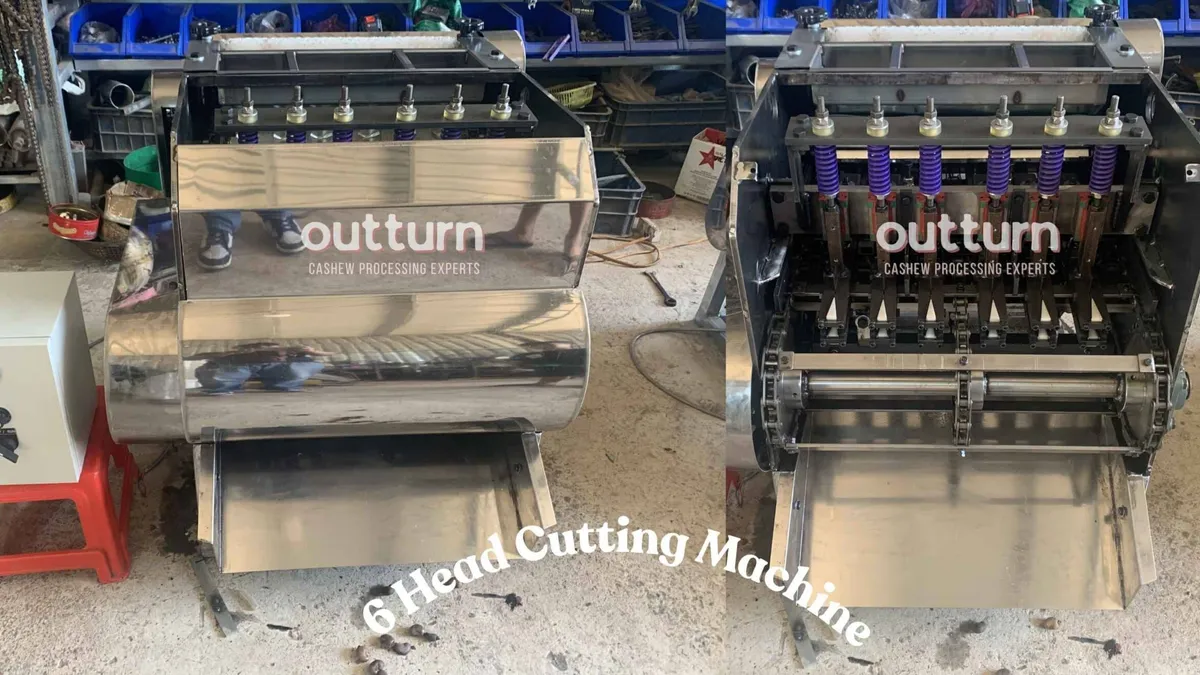
If you’re researching cashew cutting machines for the first time, the term itself can be confusing — it covers everything from a single manual-feed cutter an operator loads by hand to a fully automated line processing over a tonne of raw cashew nut (RCN) per hour. This guide lays out where cutting fits in the overall processing chain, how OUTTURN’s machine range is organized, and how pricing actually works, so you can approach a quote request already knowing what to ask for.
Where Cutting Fits in Cashew Processing
Cashew processing runs through several stages before RCN becomes packaged kernel: receiving and drying, steaming (to soften the shell along its natural seam), cutting, CNSL removal, shell separation, peeling, grading, and final drying. The cutting machine’s specific job is narrow but critical — split the shell cleanly along that softened seam without crushing or breaking the kernel inside. Get this stage wrong and every downstream step inherits the damage, since a cracked or broken kernel can’t be recovered as whole grade no matter how well the rest of the line runs. For a full walkthrough of how each stage connects to the next and how to size equipment against your own volume, see our guide to designing a cashew cutting line.
Standalone Cutters vs. Automatic Lines
OUTTURN sells two broad categories of equipment. Standalone head-count machines (2- through 12-head) do the cutting step only — a processor either already has sieving, CNSL removal, and kernel extraction in place, or handles those steps manually. A complete automatic line, by contrast, ties multiple cutting units together with a vibration sieve, centrifuge, air blower, roller separator, and scooping stage into one continuous flow, so RCN goes in and clean kernel comes out with only a couple of operators managing the control panel. The automatic cashew nut cutting machine page covers that complete line in detail, including throughput and staffing.
Head-Count Options: 2 Through 12
Every OUTTURN head-count machine shares the same core mechanism — adding heads adds parallel cutting stations, so capacity scales roughly with head count rather than machine complexity, while motor size steps up only twice across the whole range (1 HP from the 2-head through the 8-head, 1.5 HP on the 10-head, 2 HP on the 12-head). As a rough guide: a 2-head machine handles about 40–55 kg/hr and suits pilot runs or small operations, while head counts step up through 4, 6, 8, and 10 heads to a 12-head machine handling roughly 240–280 kg/hr. Beyond that range, most processors move to a full automatic line — typically four parallel cutting units — rather than continuing to add standalone machines, since throughput of 1,000+ kg/hr benefits from the integrated sieving and separation stages built into a line.
How Pricing Works: Factory-Direct FOB Vietnam
Every OUTTURN machine ships factory-direct from Bình Phước, Vietnam, which removes the importer or distributor margin that typically sits between a manufacturer and a processor. Where we have a stable, confirmed base configuration — the automatic line and factory-refurbished used machines — we publish a firm FOB Vietnam price. Head-count cutters are configuration-dependent, so we confirm pricing directly once we know your target daily volume and RCN origin, rather than quoting a number that may not fit your actual operation. Freight, insurance, and import duties to your destination are always quoted separately from the FOB machine price. The full current price list is on our cashew cutting machine price page.
Where to Go Next
If you’re still working out what configuration fits your volume, start with the line design guide. If you’re comparing manufacturing origins, the Vietnam vs India comparison covers how the underlying cutting mechanism differs between the two. If you already know roughly what you need and just want numbers, the pricing page and the automatic line page are the fastest next stops.