
Skip to content
OUTTURN Cashew Cutting Machines
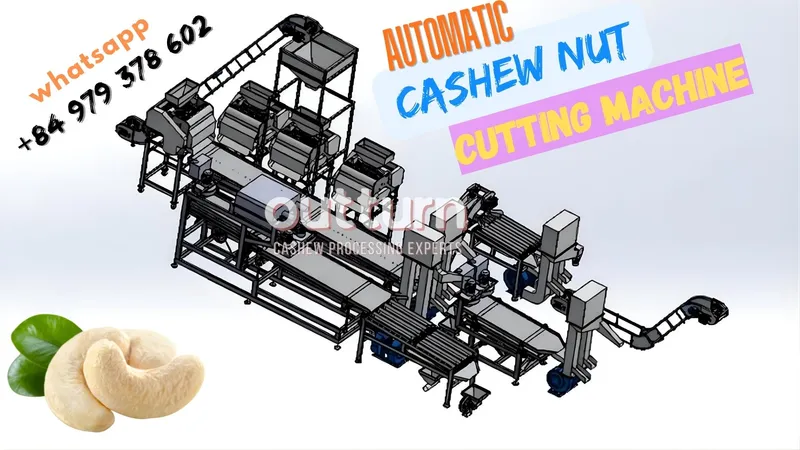
Complete OUTTURN automatic cashew nut cutting line with multiple cutting heads, sieve, and centrifuge in a Vietnam factory
1,000–1,200 kg/hr (complete line)Up to 76% Outturn

Automatic Cashew Nut Cutting Machine — Complete Line

SKU: CACM.OUTTURN.26

$12,000 FOB Vietnam, complete automatic line

Cutting heads
4x 8-head or 10-head units (32–40 heads total)
Line throughput
1,000–1,200 kg/hr raw cashew nut (RCN)
Total connected load
7–9 kW (complete line, all stages)
Voltage
380V, 3-phase, 50Hz (other voltages available on request)
Sieve
Vibration sieve, double or triple deck
Centrifuge speed
1,200+ RPM (CNSL extraction)
Blade material
Hardened alloy steel, factory-sharpened
Operators required
2 workers from one central control panel

How the OUTTURN Automatic Cutting Line Works

The material flow through a complete OUTTURN automatic line, from raw cashew nut infeed to clean, food-safe kernel output.

  1. 1

    RCN infeed

    Raw cashew nuts are loaded into the infeed tank and carried by conveyor to the bank of cutting heads, keeping a steady, even feed rate across all machines.

  2. 2

    Cutting

    Four 8-head or 10-head cutting machines run in parallel, each shell mounted in a cup and split by a descending blade calibrated to the nut size grade being processed.

  3. 3

    Sieve separation

    Cut shells and kernels drop onto a vibration sieve (double or triple deck), which grades and separates material by size ahead of the next stage.

  4. 4

    Centrifuge (CNSL removal)

    Shell pieces pass through a centrifuge spinning at 1,200+ RPM, which flings off cashew nut shell liquid (CNSL) — the caustic phenolic oil that causes skin burns and must be cleared for safe handling and food-grade output.

  5. 5

    Blower shell discharge

    A pneumatic air blower separates lighter shell waste from kernel and shell-attached pieces, discharging the shell fraction out of the line.

  6. 6

    Roller separation and recirculation

    A roller separator catches nuts that were not fully cut or scooped. A bucket elevator returns this fraction — typically 5–8% of throughput on a well-calibrated line — to be reprocessed rather than lost.

  7. 7

    Scooping and kernel output

    A scooping machine lifts kernels still partly seated in the shell free of the shell wall, and the line delivers clean whole and broken kernel ready for the peeling and grading stages.

An automatic cashew cutting line is what a processor reaches for once volume outgrows a bank of standalone cutters and manual sorting. Instead of RCN moving between separate machines and tables by hand, OUTTURN’s automatic line ties the cutting, separation, CNSL removal, and kernel-extraction stages into a single continuous flow, built and trialled as one system before it ships from our Bình Phước factory.

Built as one integrated line

The line’s core is four 8-head or 10-head cutting machines running in parallel, each processing roughly 250–300 kg/hr of raw cashew nut. That gives the complete line a combined capacity of 1,000–1,200 kg/hr, sized for mid-size to larger processing operations that need consistent daily throughput rather than a single-machine bottleneck.

Around the cutting stage sits the equipment that actually makes it a line rather than four machines side by side: a vibration sieve (double or triple deck, depending on your RCN grade mix) to separate material by size, a centrifuge spinning at 1,200+ RPM to strip cashew nut shell liquid (CNSL) — the phenolic oil that burns skin on contact — off the cut shell and kernel, a pneumatic air blower to discharge lighter shell waste, and a roller separator that catches anything not fully cut or scooped and sends it back for another pass via bucket elevator.

Why the centrifuge and scooping stages matter

Cutting the shell is only the first step. Two stages downstream of the cutters are what determine whether a line produces genuinely food-safe, high-recovery kernel or just split shells with a mess to clean up by hand.

The centrifuge is a food-safety stage, not an optional extra — CNSL residue on kernel is a contact hazard and a quality problem, and no processor should be running cut kernel without it being cleared. The scooping machine, meanwhile, is what lifts kernel that’s still partly wedged inside a shell half free without breaking it, which is standard practice on well-run Indian and Vietnamese lines and meaningfully improves whole-kernel recovery over relying on manual extraction.

Power draw and staffing

A complete four-cutter automatic line draws approximately 7–9 kW across all stages combined, and is designed to run from a single central control panel that two operators can manage — one watching infeed and cutting, one watching the sieve/centrifuge/output end. That’s a modest footprint for the throughput: processors moving from manual or semi-manual cutting typically see a significant drop in the labor needed per tonne of RCN processed.

Tested before it ships

Every OUTTURN automatic line is trialled with real raw cashew nut on our factory floor before shipment. We run RCN through the complete line, measure the resulting whole-kernel outturn rate, and document it, so what arrives at your facility is a line whose performance we’ve already verified rather than one you’re calibrating blind on day one.

Sizing it to your operation

Not every processor needs the full 1,000–1,200 kg/hr configuration. If your current volume is lower, our standalone head-count cutting machines (2- through 12-head) let you build toward a line incrementally, or fit into a facility that already has sieving and separation equipment in place. Tell us your RCN volume, nut size grade, and available power, and we’ll recommend the configuration that actually matches your operation rather than oversizing it.

Frequently Asked Questions — Automatic Line

What's the difference between a standalone cutting machine and this automatic line?
A standalone cutter (2- to 12-head) is a single machine that splits the shell and needs a processor to already have sieving, CNSL handling, and kernel extraction set up around it, or to do those steps by hand. The automatic line bundles four cutting machines with the sieve, centrifuge, blower, roller separator, and scooping stage into one integrated flow, so RCN goes in one end and clean kernel comes out the other with only two operators watching the panel.
What does the scooping machine actually do?
After cutting, some kernels stay partly seated inside one half of the shell rather than dropping free. The scooping machine lifts that kernel out of the shell cavity without breaking it, which is standard practice on Indian and Vietnamese cutting lines and improves whole-kernel recovery compared with relying on manual scooping alone.
What happens to nuts that don't get fully cut or scooped?
The roller separator is built to catch this fraction — nuts that pass through cutting or scooping incompletely. Rather than being lost as waste, a bucket elevator carries them back to the front of the line for another pass. On a properly calibrated line this recirculation is roughly 5–8% of total throughput, which is a normal, expected part of the process rather than a fault.
How many cutting heads do I need to hit 1,000 kg/hr?
Our standard configuration for the 1,000–1,200 kg/hr line uses four 8-head or 10-head cutting machines running together, each handling roughly 250–300 kg/hr of RCN. If your target volume is lower, a smaller number of standalone head-count machines may suit you better than a full automatic line — tell us your target and we'll size it correctly.
What's the difference between the sieve deck options?
A double-deck vibration sieve does two passes of size separation, which is sufficient for many operations. A triple-deck sieve adds a third separation stage, giving finer size grading and cleaner downstream sorting for processors handling mixed nut-size grades or aiming for tighter kernel size consistency. We'll recommend the right deck count based on your RCN grade mix.
What is CNSL and why does the centrifuge matter?
CNSL (cashew nut shell liquid) is the dark, caustic phenolic oil found in the shell — it causes skin and respiratory irritation on contact and must be cleared from the kernel stream for safe handling and food-grade output. The centrifuge spins cut material at 1,200+ RPM to fling this oil off the shell and kernel surfaces, which is why it's a non-negotiable stage in any line meant to produce food-safe kernel rather than just split shells.
Do you sell the complete line, or just the individual cutting machines?
Both. This page covers the complete automatic line — cutters, sieve, centrifuge, blower, roller separator, and scooping stage as one integrated system. If you only need the cutting stage, our head-count machines (2- through 12-head) are sold standalone for processors building or expanding a line with equipment they already have.

Get a Complete Line Specification

Tell us your daily RCN volume, origin, and shift hours — we'll recommend the right configuration, factory-direct from Vietnam.