
Skip to content
OUTTURN Cashew Cutting Machines
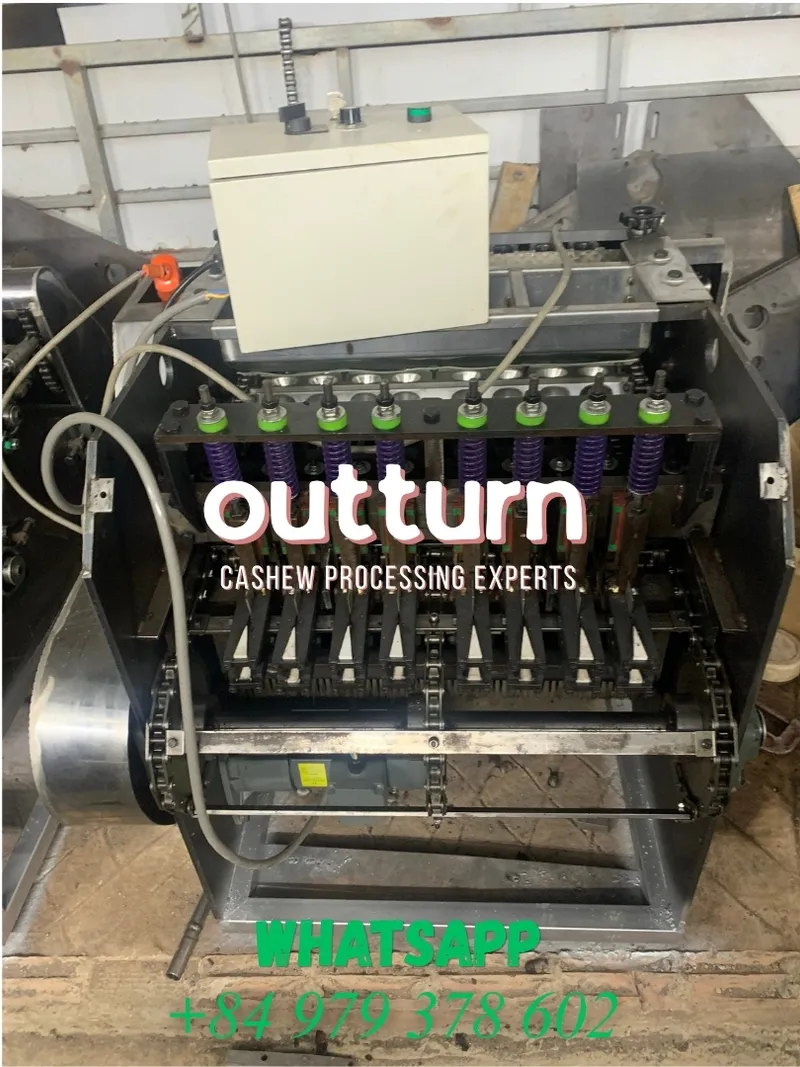
OUTTURN 8-head cashew nut cutting machine showing eight rotary cutting cups arranged around the central turret
160–195 kg/hrUp to 75% Outturn

8-Head Cashew Nut Cutting Machine

SKU: OUTTURN-CCM-8H

Factory-Direct Pricing — Request a Quote

Cutting Stations
8 rotary cutting heads (cups)
Motor Power
0.75 kW electric motor driving all 8 stations
Voltage
220V single-phase or 380V three-phase, 50Hz (configurable by destination)
Blade Material
Hardened stainless steel cutting blades
Frame
Powder-coated steel machine frame with stainless contact parts
Net Weight
Approx. 165 kg
Dimensions (L x W x H)
Approx. 1500 x 700 x 1200 mm
Warranty
12-month manufacturer warranty on motor and mechanical components

How the 8-Head OUTTURN Cutting Machine Works

The 8-head machine cuts steamed cashew nuts one at a time across eight rotary cutting cups, so loading, cutting, and ejection all happen in the same continuous cycle.

  1. 1

    Load the nut

    An operator places one steamed and humidified raw cashew nut into an empty cutting cup as it passes the loading position on the rotary turret.

  2. 2

    Index to the blade

    The camshaft-driven turret advances the loaded cup through its rotation until it reaches the fixed cutting station.

  3. 3

    Cut the shell

    At the cutting station, the blade closes through the shell along the nut's natural seam, splitting it into two halves and freeing the kernel inside.

  4. 4

    Eject shell and kernel

    As the cup continues rotating past the blade, the cut shell and kernel drop through a chute into separate collection trays below.

  5. 5

    Cup returns for reloading

    The now-empty cup completes its rotation back to the loading position, ready for the operator to load the next nut.

  6. 6

    Continuous cycle across all 8 heads

    Because all eight cups are at different points in the cycle simultaneously, one operator can keep loading nuts while cutting and ejection happen in parallel at the other stations.

Built for Mid-to-Large Processing Lines

The 8-head OUTTURN cashew nut cutting machine sits toward the upper-middle of our head-count range, designed for processors who need meaningfully more throughput than a 6-head unit but aren’t yet ready to commit floor space and staffing to a 10 or 12-head machine. Like every machine in the OUTTURN lineup, it’s built and tested at our facility in Bình Phước, Vietnam, before shipping factory-direct to processors across Africa, Asia, and South America.

The Rotary Cutting Mechanism

Every OUTTURN cutting machine, regardless of head count, works on the same core principle: a single electric motor drives a camshaft that rotates a turret of cutting cups through a continuous cycle. On the 8-head model, eight of these cups are arranged around the turret, each holding one steamed cashew nut at a time.

As the turret rotates, each cup passes through three functional zones in sequence. First, at the loading position, an operator places a raw, pre-steamed nut into an empty cup. The cup then rotates through to the fixed blade station, where the cutting blade closes through the shell along the nut’s natural seam, splitting it cleanly and releasing the kernel. From there, the cup continues rotating past a chute where the cut shell and kernel drop away into separate collection trays, before the empty cup completes its rotation back to the loading position to begin the cycle again.

Because all eight cups are at different points in this cycle simultaneously, cutting and ejection are happening continuously even though the operator is only physically loading one nut at a time. This is what lets a single motor and a single operator support meaningfully higher throughput as head count increases.

Scaling by Heads, Not Motor Size

A question we get often is why an 8-head machine doesn’t need a bigger motor than a 2-head machine. The answer is that the 0.75 kW motor isn’t doing the cutting work directly on each nut — it’s driving the camshaft mechanism that indexes the turret. Adding cutting stations increases how many nuts are mid-cycle at any given moment, which raises throughput, but it doesn’t change the mechanical load the motor has to overcome to advance the turret one step. This is the same design principle across our full range, from the compact 2-head unit up through the 12-head model, which keeps maintenance and spare parts consistent across the whole product line.

Capacity and Outturn

The 8-head machine is rated for an estimated 160–195 kg/hr of raw cashew nut throughput, with typical whole-kernel outturn around 75% when nuts are properly steamed and humidified before cutting. As with any cutting machine in this class, actual results depend heavily on raw material quality and operator consistency — two nuts of the same variety but different moisture content can cut very differently under the same blade.

Where It Fits on Your Line

Processors running the 8-head model often pair multiple units side by side to hit a target daily volume, since scaling output by adding machines is generally more predictable than trying to push a single unit beyond its rated capacity. If you’re evaluating head counts for a new or expanding line, it’s worth sizing against your intended daily kernel output first, then working back to how many 8-head (or other) units you’ll need to get there.

Frequently Asked Questions — 8-Head Cutter

How does the 8-head machine differ from OUTTURN's other head-count models?
All OUTTURN cutting machines, from 2-head to 12-head, use the same 0.75 kW motor driving a camshaft-actuated rotary turret. What changes between models is the number of cutting stations (cups) arranged around that turret, not the motor size. Adding heads increases how many nuts are being loaded, cut, and ejected in parallel at any moment, which raises throughput without requiring a larger motor. The 8-head model sits in the middle of the range, above the 2, 4, and 6-head units and below the 10 and 12-head units.
How many operators does one 8-head machine need?
Typically one operator per machine. Because the eight cups are at different stages of the cutting cycle at any given moment, a single person loading nuts steadily into each cup as it reaches the loading position can keep the machine running near its rated capacity. Some processors add a second person nearby for kernel sorting or tray changeovers, but that is a line-staffing decision rather than a requirement of the machine itself.
What preparation do raw cashew nuts need before cutting?
Raw cashew nuts need to be steamed or roasted and then conditioned to the right moisture level before they reach the cutting machine. Properly humidified shells cut cleanly along the seam and release the kernel with less breakage; nuts that are too dry tend to shatter under the blade instead of splitting evenly. Getting this pre-treatment step right has a bigger effect on your actual outturn than any adjustment to the machine itself.
What outturn percentage can I expect from the 8-head machine?
Under proper operating conditions, with well-steamed and correctly humidified nuts, this model typically achieves an estimated whole-kernel outturn of around 75%, meaning roughly three-quarters of cut kernels come out as intact halves rather than broken pieces. Actual results vary with raw nut quality, moisture consistency, and operator technique, so this figure should be treated as a typical benchmark rather than a guarantee for every batch.
When should I choose the 8-head machine instead of a 6-head or 10-head model?
The 8-head machine is a good fit for processors who have outgrown a 6-head unit's throughput but don't yet need the higher output and larger footprint of a 10 or 12-head machine. It's a common choice for mid-sized processing lines running multiple machines side by side, since it balances a meaningful capacity increase with a manageable floor footprint and staffing requirement. If you're unsure which head count matches your target daily volume, it's worth working backward from your intended kg/day output.
What voltage and power supply does the 8-head machine require?
The machine runs on a single 0.75 kW motor and can be configured for either 220V single-phase or 380V three-phase power at 50Hz, depending on what's available at your facility. Let us know your local voltage and phase standard when ordering so the unit is wired correctly before it ships, since electrical standards vary considerably across Africa, Asia, and South America.

Get a Complete Line Specification

Tell us your daily RCN volume, origin, and shift hours — we'll recommend the right configuration, factory-direct from Vietnam.