
Skip to content
OUTTURN Cashew Cutting Machines
Cashew Cutting

How to Choose the Right Cashew Cutting Machine for Your RCN Grade

Updated June 15, 2026

Sorted trays of raw cashew nuts in different size grades next to an OUTTURN cutting machine

Why Grade, Not Just Volume, Should Drive Machine Selection

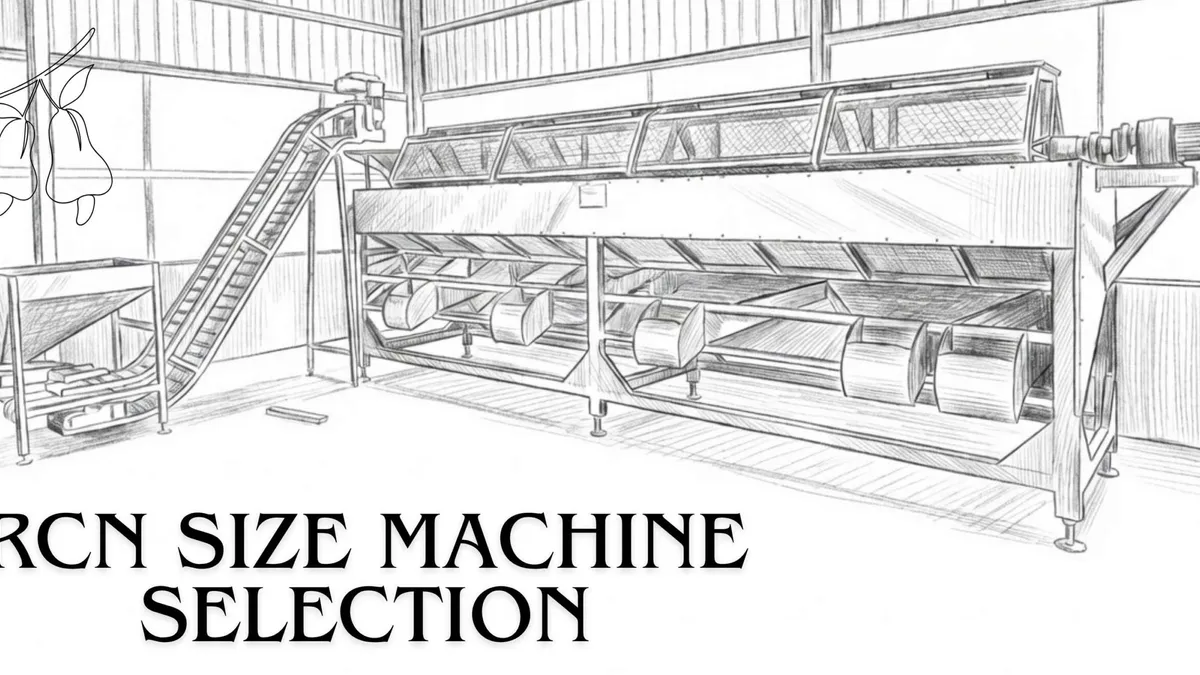
Most cashew processors size a cutting line around one number: target daily kilograms of raw cashew nuts (RCN). That number matters, but it only tells you how much total capacity you need — it says nothing about how that capacity should be split. The grading system used across the sizing tools on this site groups RCN by nut size into five practical bands, A+ through D, largest to smallest. That grade mix, not the daily volume alone, is what should actually determine how many cutting heads you run and how each one is set up.

Why Grade Mix Varies by RCN Origin

Nut size distribution isn’t uniform across origins. Southeast Asian RCN, including much of Vietnam’s own crop, tends to skew toward a higher share of A+ and A grade nuts on average. Several West African origins commonly show a larger combined share of B, C, and D grade nuts within the same lot, alongside meaningful variation between growing regions in the same country. These are general, hedged tendencies rather than fixed figures — actual mix shifts with season, rainfall, and even which aggregator a given truckload came through — which is why sampling your own incoming RCN matters more than assuming a textbook split for your country.

Why One Blade-Gap Setting Hurts Mixed Lots

A cutting head’s blade gap and cup size are mechanical settings tuned to a specific nut size range. Set that gap for the average size in a mixed lot, and both ends of the distribution suffer: A+ nuts arrive too large for the gap and often come out partially split rather than cleanly halved, while D-grade nuts sit loosely in a cup sized for bigger nuts and get crushed instead of sheared along the seam. Neither failure mode is a machine defect — it’s a mismatch between a fixed setting and a variable input. The practical fix is separating grades before cutting and running each through a head or head group tuned specifically for that size band.

A Practical Framework for Sizing Heads per Grade

Once you have a sampled grade mix, sizing heads per grade is arithmetic: convert your target daily throughput into kg/hr for each grade band using that mix’s percentages, then divide by an estimated per-head throughput to get a head count per band, rounded up to a sellable machine configuration. Rather than working through that by hand, use the Cutting Line Design Calculator on our cutting-line design guide — enter your daily RCN volume, working hours, and RCN origin, and it returns a starting-point head-count recommendation broken down by grade. Treat its output as a planning baseline to confirm against your own sampled lots, not a fixed spec.

Plan for Recalibration, Not a One-Time Setup

Grade mix isn’t static. Switching RCN origin or supplier, moving between early and late harvest windows, or simply sourcing from a new aggregator within the same region can all shift the size distribution reaching your cutting line. A line calibrated once and left untouched will quietly lose outturn as that mix drifts, even if total daily volume stays exactly the same. Building a habit of re-sampling a fresh lot and re-checking grade-band outturn whenever your RCN source changes is a small, low-cost step that protects the gains a properly grade-matched cutting line is designed to deliver.

Frequently Asked Questions

What do the RCN grades A+, A, B, C, and D actually refer to?
They're a practical size-banding used across our cutting-line sizing tools to group raw cashew nuts (RCN) by nut size, from A+ (largest) down to D (smallest), within a given lot. Size correlates closely with how a nut behaves under a cutting blade, so grading by size — rather than treating a lot as one uniform batch — is what lets a cutting line be tuned properly. It is a working classification for machine setup, not a formal industry export-grading standard for kernels.
Can one cutting machine head handle more than one grade?
A single head can technically cut nuts outside its ideal size range, but breakage rises the further a nut sits from the blade-gap setting it was tuned for. A gap set for A+/A nuts will often fail to fully engage a small D-grade nut, while a gap set for D-grade nuts can crush or split A+ nuts unevenly. For any lot with a meaningful size spread, dedicating separate heads or head groups to different grade bands consistently outperforms one shared setting.
How many heads should I dedicate to each grade?
Start from your typical grade mix as a percentage of daily RCN volume, then apply that percentage to your target daily throughput to get a kg/hr figure per grade. From there, head count follows from estimated per-head throughput plus a working buffer for downtime and reloading. Our Cutting Line Design Calculator, on the how-to-design-a-cashew-cutting-line guide, runs this calculation for you from your daily volume, working hours, and RCN origin.
Does grade mix really change that much between RCN origins?
Yes, meaningfully. Origins with larger average nut sizes, such as much of Southeast Asia, tend to skew toward a higher share of A+ and A grade nuts, while some West African origins commonly run a larger combined share of B, C, and D grades in the same lot. These are general, hedged tendencies rather than fixed rules — actual mix varies by season, region within a country, and even by aggregator — which is exactly why sampling your own incoming lots matters more than relying on an origin average.
What actually goes wrong if I run mixed grades through one blade-gap setting?
Breakage climbs at both ends of the size distribution. Nuts larger than the setting was tuned for tend to resist a full, clean cut and come out partially split or torn, while nuts smaller than the setting can shift inside the cup and get crushed rather than sheared cleanly along the seam. Both outcomes push kernels into the lower-value broken grade instead of whole halves, which shows up directly as a lower overall outturn percentage even though the machine itself is running normally.
How often should I recalibrate for grade mix?
Recalibrate whenever your RCN source changes in a way that could shift nut size, not on a fixed calendar. That includes switching origin countries, changing regional suppliers or aggregators within the same country, and moving between early and late harvest windows in a single season, since nut size can drift as a harvest progresses. A quick re-sample and re-sort of a fresh lot is a low-cost check against a real drop in outturn from an outdated setting.

Have a Question We Didn't Cover?

Tell us about your setup and we'll walk you through the right configuration.