
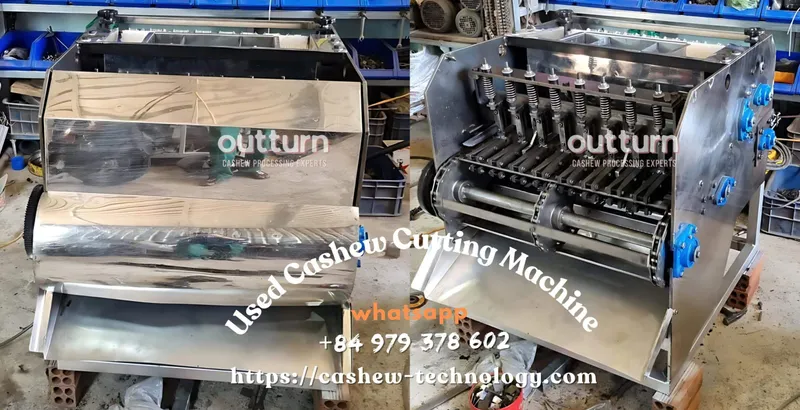
For processors who need real cutting capacity on a tight budget, a factory-refurbished used machine can be the most practical entry point into mechanized cashew cutting. OUTTURN sources, inspects, and rebuilds used cutting machines at its facility in Bình Phước, Vietnam, rather than reselling equipment as-is. Every unit goes through the same 8-step refurbishment process before it is offered for sale, so “used” does not mean “unverified.”
Why buy refurbished instead of new
A new cutting machine gives you the longest possible service life and zero prior operating hours, but it also carries the highest upfront cost. A refurbished machine trades some of that long-term margin for a much lower entry price, which matters for smaller processors, seasonal operations, or buyers testing mechanized cutting for the first time before committing to a larger line. Because OUTTURN rebuilds the wear-critical components rather than simply cleaning and repainting the unit, a refurbished machine can deliver whole-kernel outturn close to what a new machine achieves, even though the frame and drivetrain have prior hours on them.
What refurbishment actually covers
Not every part on a used machine wears at the same rate. OUTTURN’s process focuses on the components that determine cut quality and reliability:
- Cutting cups — replaced, since these hold each nut during the cut and take the most repeated mechanical contact.
- Blade and blade assembly — replaced as a set, because a worn blade or a loose assembly is the single biggest driver of broken kernels.
- Cam mechanism and followers — inspected and replaced where clearance has opened beyond tolerance, since this is what times every cut.
- Brushes — replaced to keep kernel handling consistent through the cycle.
- Frame — checked specifically for corrosion caused by cashew nut shell liquid (CNSL), a common failure point on older machines that sat in humid processing environments.
- Motor — tested for condition and correct output before it goes back into service.
How the machine is verified before it ships
Refurbishment alone doesn’t prove a machine is ready. Every unit runs through a two-stage trial. Stage 1 is an extended dry run with no cashews loaded, which surfaces timing or vibration issues that a quick spin test would miss. Stage 2 is a real-product trial using actual raw cashew nuts (RCN), where the whole kernel rate is measured and recorded. Only machines that clear both stages are cleared for shipment, which is why OUTTURN can quote an expected outturn percentage on a used unit rather than leaving buyers to find out after installation.
Available configurations
Used machines are refurbished across the full head-count range, from 2-Head units suited to small or trial operations up to 12-Head machines for higher-volume processors, giving a capacity span of roughly 40–280 kg/hr depending on configuration. Exact stock varies, so it’s worth confirming current availability for your target head count directly.
Buying used from another source
If you’re evaluating a used cutting machine from a seller other than OUTTURN, the same checklist applies. Look closely at the cutting cups and blade assembly for wear, check the cam mechanism and followers for play, inspect the frame for CNSL corrosion around joints and mounting points, and ask to see the motor run under real load. A dry-run demonstration is not enough — insist on a real-product cutting test so you can see whole-kernel performance for yourself before agreeing on a price.