
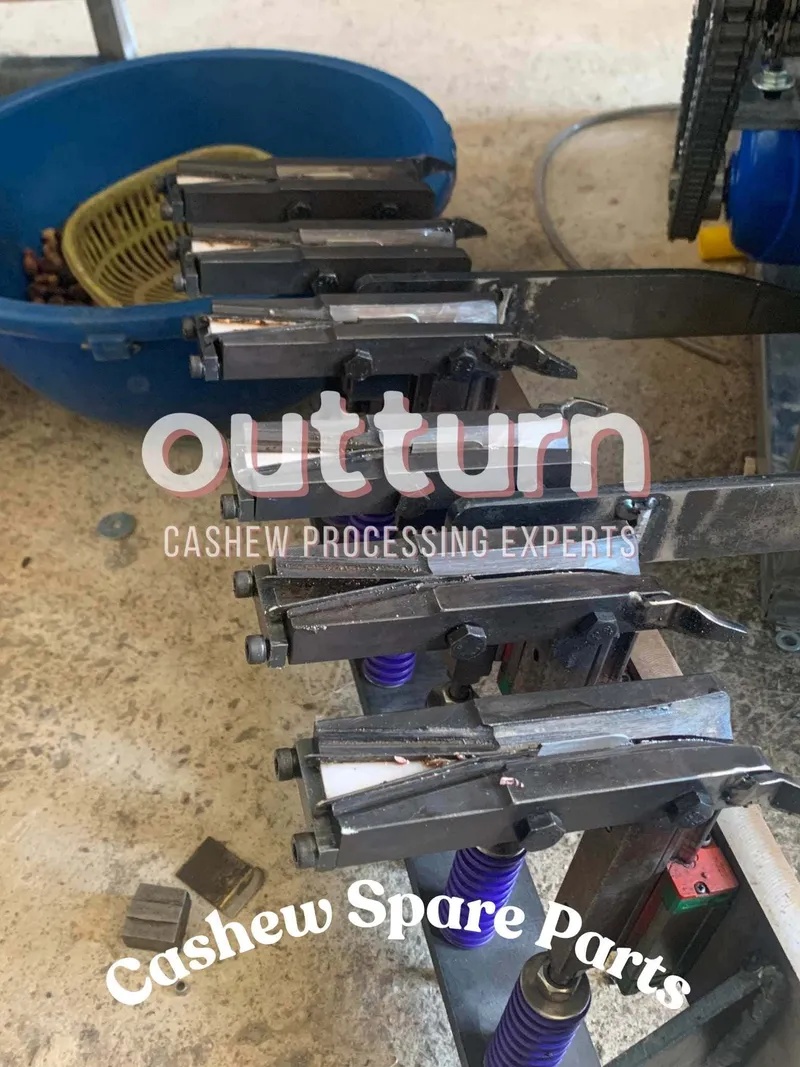
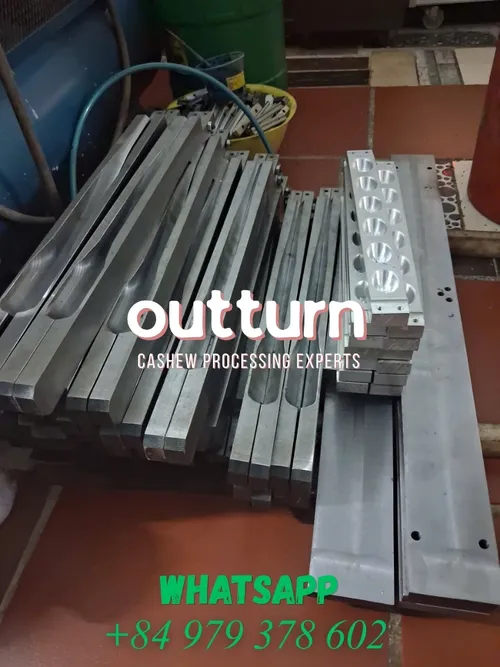
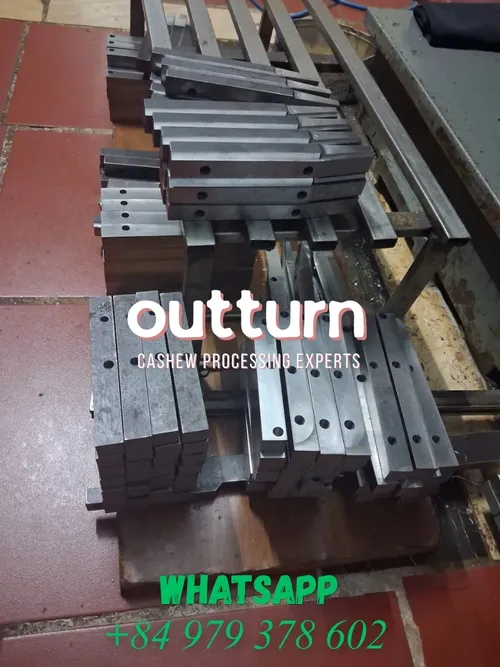
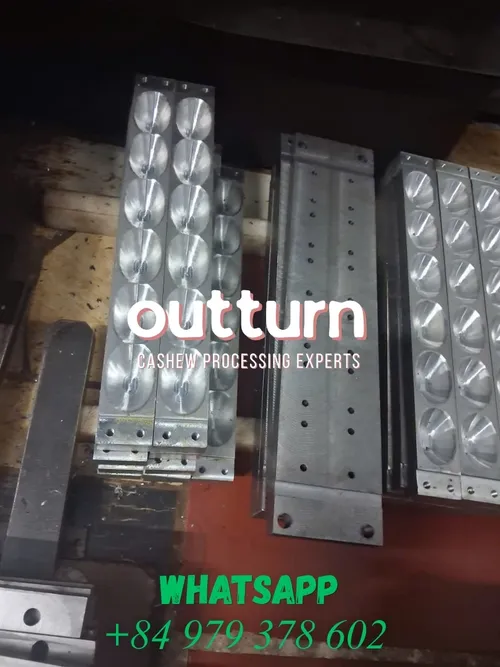

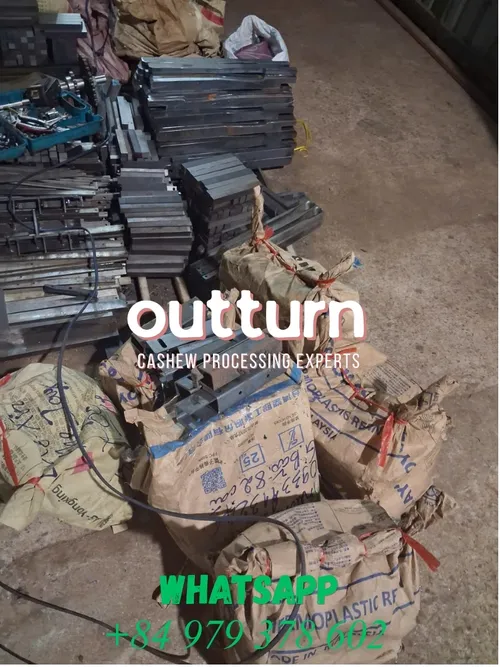

Keeping an OUTTURN cutting line running at full output depends less on the machine itself than on the condition of a handful of small, fast-wearing parts. Blades, cutting cups, springs, and guides all take repeated mechanical contact on every cycle, and their condition has a direct, measurable effect on your whole-kernel recovery rate. We manufacture and stock the same wear parts that ship inside every new OUTTURN machine, so processors can replace worn components with an exact factory match rather than a generic substitute.
What we stock
Every part that a 2-Head through 12-Head OUTTURN machine is built from is kept in stock at our factory in Binh Phuoc, Vietnam:
- Standard cutting blades
- Cutting cups
- Complete blade assembly sets (blade, cup, and guide matched together)
- Guides and springs
- Sharpening jigs for on-site blade resharpening
- Brushes and cam followers
- Bearings and motors
- Complete service kits bundling the above for scheduled maintenance
Because these are the same components used in current production, fit is consistent across the OUTTURN range rather than being a one-off custom order. The motor is the one exception: the 2- through 8-head machines take a 1 HP (0.75 kW) motor, the 10-head 1.5 HP (1.1 kW) and the 12-head 2 HP (1.5 kW), so tell us the head count when ordering a replacement.
Why blade condition drives your yield
The cutting blade is the single part most responsible for how much of your raw cashew nut converts into saleable whole kernels. A precision-ground blade produces a clean separation between shell and kernel, which keeps fines and breakage to a minimum. As a blade dulls or shifts slightly out of alignment through normal wear, that clean separation degrades — kernels start breaking unevenly and fines increase, which shows up directly as a lower outturn percentage even though nothing else about the machine has changed. This is why we treat blade maintenance as a yield issue, not just a mechanical one, and why we supply a sharpening jig alongside replacement blades: resharpening on schedule is often more cost-effective than waiting for a full replacement cycle.
Ordering and fit
We ask for two things before dispatching any part: your machine’s head count, and either the part name or a description or photo of the worn component. This lets us confirm compatibility before anything ships, which matters especially for processors running older machines where exact dimensions are worth double-checking. Once confirmed, in-stock parts are dispatched within 48 hours from the factory, so a worn blade or cracked cup doesn’t have to mean days of idle capacity on your line.
Planning maintenance instead of reacting to it
Processors running machines at or near their rated capacity tend to get the most value out of scheduling wear-part replacement proactively — swapping blades, cups, and springs on a set interval — rather than waiting for a visible drop in outturn or a jam to force the issue. A complete service kit makes this easier to plan around, since it covers the components most likely to need attention in a single order rather than several separate ones. If you’re unsure what your current maintenance interval should be, tell us your head count, approximate daily runtime, and RCN throughput, and we can help you think through a reasonable schedule.