
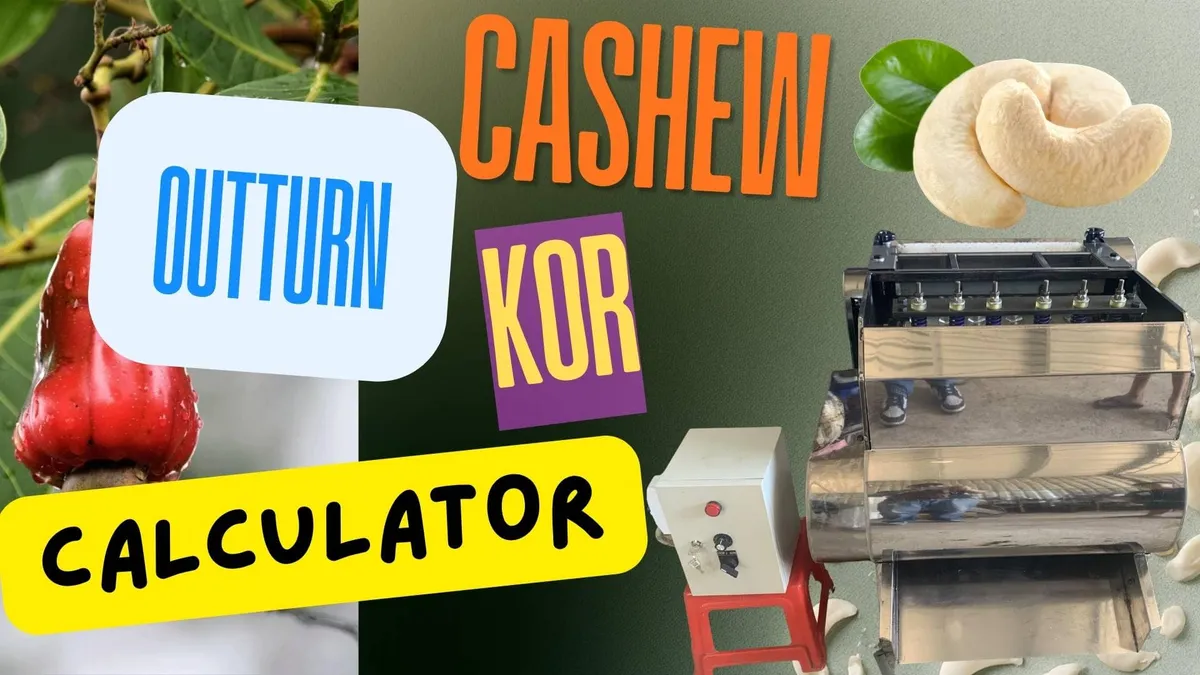
Ask anyone who has bought or sold raw cashew nuts (RCN) and they will use the word before they explain it: outturn. It is the single figure that tells a buyer, in advance, roughly how much finished kernel a given lot of RCN will yield once it is steamed, cut, peeled, and graded — and it is the number that ultimately decides whether a shipment was priced fairly on either side of the deal.
What “Outturn” Actually Means
Outturn is the cashew industry’s own term for Kernel Output Ratio, or KOR: the weight of finished white kernel a processor recovers from a given weight of raw cashew nut. It is a yield measurement, not a quality grade in the way W240 or W320 describe kernel size — a lot can carry a strong outturn and still need grading afterward to sort the kernel into size classes. What outturn tells you upfront is simply how much kernel, in total, a batch of RCN is likely to give back once it has been fully processed.
The KOR Formula, and Why 80kg
RCN is traded almost everywhere in 80kg bags, so the industry expresses KOR against that same 80kg basis rather than against a plain percentage. The formula is straightforward:
KOR = (finished white kernel grams per kg of RCN ÷ 1000) × 80
In practice, a processor tracks how many grams of finished kernel they recover per kilogram of RCN run through their line, divides by 1000 to convert that into a per-kg fraction, then multiplies by 80 to express it against the standard trading bag. The result is a single number — say, 20 or 22 — that states, in effect, “an 80kg bag of this RCN should yield roughly this many kilograms of kernel.”
How Buyers and Traders Quote It
When a trader describes a lot as having “an outturn of 21,” they mean the KOR calculation above comes out to 21 — roughly 21kg of finished kernel expected per 80kg bag of that RCN. This is why outturn moves markets the way a grade or a moisture reading does: two lots priced at the same per-kg RCN cost can have very different real costs per kg of finished kernel if their outturns differ, because the buyer is ultimately paying for the kernel that comes out the other end, not the raw nut going in.
KOR in RCN Contracts and Procurement
Procurement teams use quoted KOR to compare competing RCN offers on equal footing, to set the price they are willing to pay per bag, and often to structure the contract itself — some agreements price RCN with an outturn guarantee, adjusting final payment up or down if the actual processed yield comes in above or below the figure quoted at purchase. Because the number carries contractual weight, buyers frequently want to verify it against their own processing results rather than accept a seller’s quoted figure at face value, particularly for large or higher-value shipments.
Why We Named Our Company OUTTURN
We chose the name deliberately. A cashew cutting machine can be marketed on throughput, price, or head count, but none of those numbers tell a processor whether the business is actually profitable — only KOR does that, because it is the figure that determines how much sellable kernel comes out of every bag of RCN purchased. Every machine we build is engineered around raising that number: blade geometry, cutting pressure, and cup timing are all tuned to reduce breakage and lift the KOR a factory achieves on real production runs, not just to post a faster kg/hr figure on a spec sheet.
Calculating Your Own KOR
The formula above is simple enough to run by hand from a single processing batch, but checking it consistently across shifts, operators, or RCN lots is easier with a dedicated tool. Our True Cashew KOR Calculator applies this same 80kg-bag formula so you can enter your own recovered kernel weight and RCN input and get a KOR figure to compare against what a supplier or buyer is quoting you.