
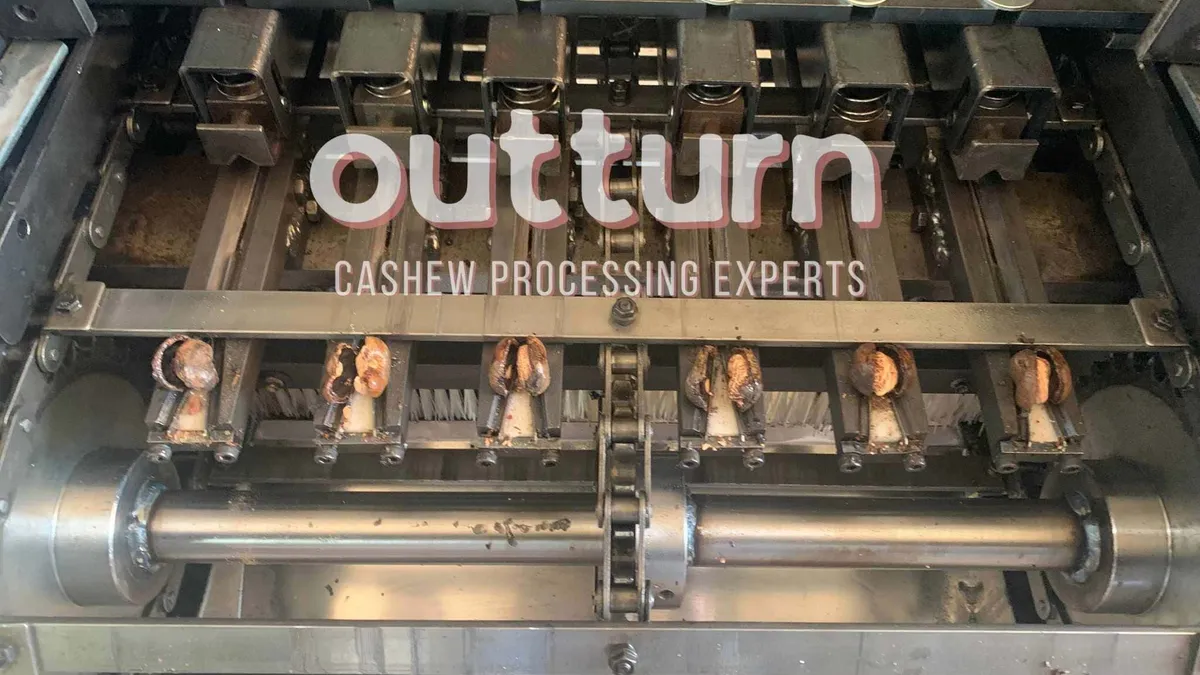
Steaming and cutting are usually discussed as two separate stages of a cashew processing line, with two separate machines, two separate operators, and two separate loss figures. On paper that’s accurate. On the factory floor, though, they behave as one coupled system: the condition steaming leaves a batch in is exactly the condition the cutting machine has to work with, and that condition does not hold still. It changes by the minute. A cutting stage that performs well on one basket of steamed RCN and poorly on the next, with no change to the machine or the operator, is very often a timing problem rather than an equipment problem.
Why Steaming Changes How a Shell Cuts
Raw cashew nut shell is hard and somewhat brittle at ambient conditions, which is part of why cutting unsteamed RCN produces poor splits and heavy kernel damage. Steaming briefly softens the shell and raises its internal moisture just enough that a blade can pass through cleanly, separating the shell from the kernel without shattering either one. This is the entire purpose of the steaming stage from a cutting-quality standpoint — it puts the shell into a short window of physical condition where a well-tuned cutter can do its job with minimal breakage.
That window does not last. As a steamed batch sits and cools, two things happen at once. Surface moisture evaporates and the shell begins re-hardening back toward its pre-steam brittleness, while at the same time any batch left stacked or covered can gain uneven moisture in patches, so some nuts in the same lot dry back out faster than others. Neither direction helps the cutting stage. A shell that has re-hardened cuts more like unsteamed RCN — more chipped kernel, more fines, more rejects. A batch with uneven moisture cuts inconsistently even within the same tray, because the blade is set for one condition and meeting several.
What This Costs at the Cutting Stage
The practical result of a steaming-to-cutting delay is higher shelling-stage loss: more broken kernel, more kernel left adhering to shell fragments, and a lower share of whole kernels in the finished output relative to what the same machine achieves on freshly steamed RCN. None of this shows up as a machine fault. The cutter is running the same speed, the same blade gap, the same operator technique — the input has simply drifted out of the condition the process was set up for. This is why two factories running identical cutting equipment can report meaningfully different whole-kernel recovery: the difference is frequently in how long RCN waits between the steamer and the cutting head, not in the machines themselves.
Keeping the Two Stages in Sync on the Floor
Synchronizing steaming and cutting is mostly a scheduling discipline rather than a capital investment, and a few practical habits cover most of it:
- Match batch sizes to cutting-line throughput. A steamer that produces more per cycle than the cutting line can process in a similar window guarantees a queue of cooling, re-hardening RCN sitting between the two stages.
- Run steaming and cutting as a pull system, not a push system. Trigger the next steaming batch based on when the cutting line is ready to receive it, rather than steaming continuously and letting output pile up.
- Track wait time as its own number, even informally — minutes from steamer discharge to first cut — rather than only tracking total shift output. A rising wait time is an early warning before it shows up as lower recovery.
- Stage cutting-line labor around steaming cycles, not the other way around, so a finished steam batch is never sitting idle for lack of an operator or open head on the cutter.
- Keep RCN intake moisture in the 8-10% range before steaming. This is the moisture band that steams evenly and predictably; RCN that starts too wet or too dry gives you a shorter, less forgiving post-steam cutting window on top of whatever delay already exists.
None of these require new equipment — they require treating steaming and cutting as one continuous process with a shared clock, instead of two stages that happen to sit next to each other on the floor plan.
Where This Shows Up in the KOR Mass Balance
If you track Kernel Output Ratio using a proper five-stage mass balance — steaming, shelling, drying, peeling, and re-heating — poor steaming-to-cutting synchronization does not appear as a new loss category. It shows up as an elevated shelling-stage loss figure, because that is the stage actually absorbing the damage from RCN that has drifted out of its optimal cutting condition. This is one of the reasons stage-by-stage tracking is worth the extra weighing it takes: a shelling loss that creeps up over a few weeks, with no change to blades or machine settings, is a legitimate signal to look at scheduling and dwell time between steaming and cutting before assuming the cutter itself needs attention.
For factories weighing batches at each stage already, this is a fast diagnostic — a wider gap than usual between expected and actual shelling loss on a given day often correlates directly with a longer-than-usual steam-to-cut interval that day. Closing that gap is typically one of the lowest-cost improvements available to a processing line, precisely because it changes nothing about the machines already on the floor.